If you’ve ever had a web app freeze mid-transaction, a server get stuck with zero running processes, or a database throw a vague "lock timeout" error with no obvious cause, you’ve almost certainly dealt with a deadlock. Most developers and sysadmins write off deadlocks as an unavoidable nuisance of running multi-process systems, but that’s not actually true. A system will never enter a deadlocked state if you intentionally design it to eliminate the core conditions that make deadlocks possible in the first place. This isn’t theoretical guesswork, it’s a proven principle of operating system design that we’ll break down with actionable, real-world steps you can implement today.
A System Will Never Enter a Deadlocked State If You Eliminate These 4 Core Deadlock Conditions
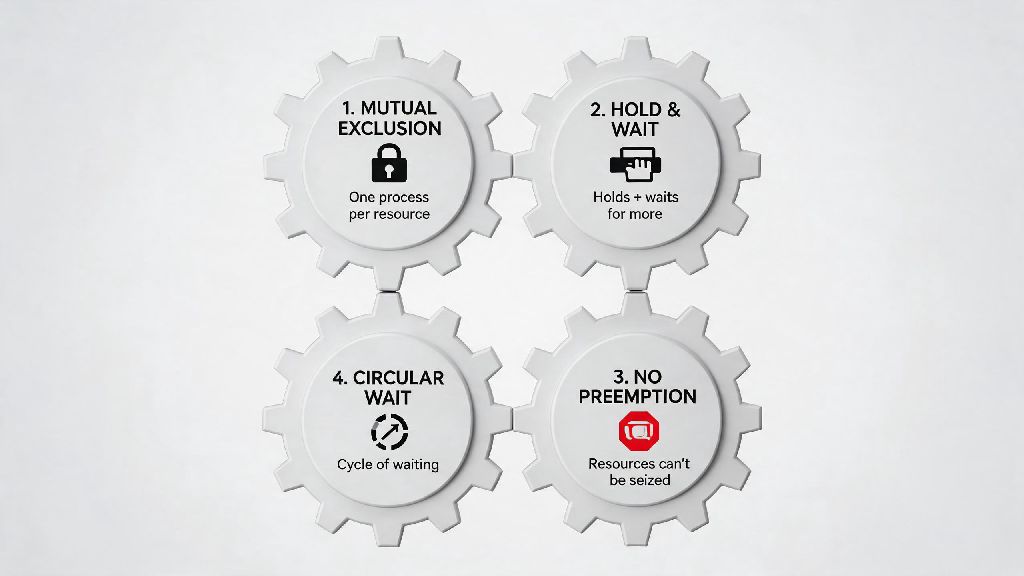
Deadlocks can only occur when four specific conditions, known as the Coffman Conditions, are all present at the same time. You don’t have to eliminate all four to prevent deadlocks, either: removing even one makes deadlock mathematically impossible. These conditions are:
That foundational rule is why a system will never enter a deadlocked state if even one of these four conditions is fully removed from your system design. For context, I’ve seen teams reduce their deadlock incident rate from 3+ per week to zero by fixing just one of these conditions for their highest-risk workflows, no full system overhaul required.
Practical Ways to Eliminate Mutual Exclusion for Low-Risk Workflows
Mutual exclusion is the most obvious of the four conditions, and it’s also the easiest to eliminate for certain types of resources. The core idea here is to make as many resources shareable as possible, so multiple processes can access them at the same time without conflict. For example, read-only database records, static asset files, and public documentation repositories are all easy to make shareable, since no process needs to modify them, so there’s no risk of data corruption from concurrent access.
For resources that can’t be made fully shareable, like physical printers or write-only storage volumes, resource virtualization is a common workaround. Print spooling is a classic example: instead of letting individual processes access the printer directly, a central spooler service manages all print jobs, so processes only interact with the virtual spool, not the physical, non-shareable printer. This eliminates mutual exclusion for end-user processes entirely, so they can never deadlock over printer access.
This approach isn’t right for every use case, though. If you’re working with sensitive data like bank account balances or patient health records, you can’t make write access shareable without risking critical data corruption. Don’t force this method if it creates more security or data integrity risk than it solves; there are three other conditions you can eliminate instead.
Breaking Hold and Wait and Circular Wait for Database and Transaction Systems
Hold and wait is one of the easiest conditions to break for batch processing and scheduled workloads. The core rule here is to require processes to request all required resources upfront before they start executing. If all requested resources aren’t available at the same time, the process waits until they are, so it never holds some resources while waiting for others. For example, if a cloud data processing job needs 2 CPU cores, 8GB of RAM, and access to a specific storage bucket, you can configure your orchestrator to only allocate all three resources if they’re all free at once.
The main downside of this method is that it can lead to resource waste. A process might hold resources it won’t use for hours while it runs earlier parts of its task, which can drive up infrastructure costs for high-volume systems. It also doesn’t work well for processes that don’t know all their resource needs upfront, like dynamic web requests that scale based on user input.
For transactional systems like e-commerce databases, breaking circular wait is almost always the more efficient choice. Global resource ordering is the standard implementation here: you assign a unique numeric ID to every resource type, and require all processes to request resources only in ascending order of their ID. For example, if you assign user table locks ID 1 and order table locks ID 2, all transactions have to request user table locks before they can request order table locks. This eliminates the possibility of a circular chain, because no process will ever hold a higher-ID resource while waiting for a lower-ID one. This is one of the most widely used deadlock prevention methods in production because it has minimal performance overhead, and it’s easy to implement with no major system rewrites.
When Preemption Is the Right Choice for High-Priority Systems
The final condition you can eliminate is the no preemption rule. Preemption means you allow the system to forcibly take resources away from a running process if needed, either to allocate them to a higher-priority process or to break a potential deadlock before it starts. If a process holding resources requests another resource that’s not available, the system can either take the held resources away and make the process restart later, or abort the process entirely to free its resources for other use.
This approach is most common in real-time operating systems where missing a deadline is far worse than restarting a process. For example, in a medical device operating system that controls a patient heart monitor, if a high-priority alert process needs a resource held by a low-priority log processing process, the system can preempt the low-priority process to avoid deadlock and ensure the alert runs on time. It’s also used in cloud hosting environments to prevent single poorly optimized processes from taking down entire server clusters.
You do need to implement guardrails if you use preemption, though. First, you’ll need atomic transaction rollback mechanisms to ensure the system returns to a fully valid state if a process is aborted mid-operation. Aborting a bank transfer halfway through, for example, could lead to lost funds if you don’t have a rollback system to reverse the partial transaction. You also need to avoid process starvation: don’t keep preempting the same process over and over so it never gets to finish. A simple priority bump system, where a process that’s been preempted multiple times gets temporarily higher resource priority, fixes this issue easily.
At the end of the day, deadlocks don’t have to be a regular, frustrating part of managing multi-process systems. We’ve covered all the core principles, and it bears repeating: a system will never enter a deadlocked state if you intentionally design it to eliminate at least one of the four required Coffman conditions. You don’t have to implement all these methods at once, either. Start with the lowest-effort fix for your specific use case: if you run a transactional database, implement global resource ordering first. If you run batch processing jobs, start with upfront resource requests. Test small changes first, track your deadlock incident rate, and adjust as needed. Over time, you’ll build a far more stable system with far fewer unexpected freezes or downtime for your users.