If you've ever spent hours troubleshooting a frozen app or unresponsive database query, you've almost certainly run into deadlock at some point. Many tech professionals new to systems design often ask how long has deadlock been in development, and the answer stretches back far further than the modern cloud tools most teams use today. What started as a niche theoretical problem in early computing has grown into a core concept every developer, sysadmin, and DevOps professional needs to understand to keep systems running smoothly.
How Long Has Deadlock Been in Development: Early Computing Origins
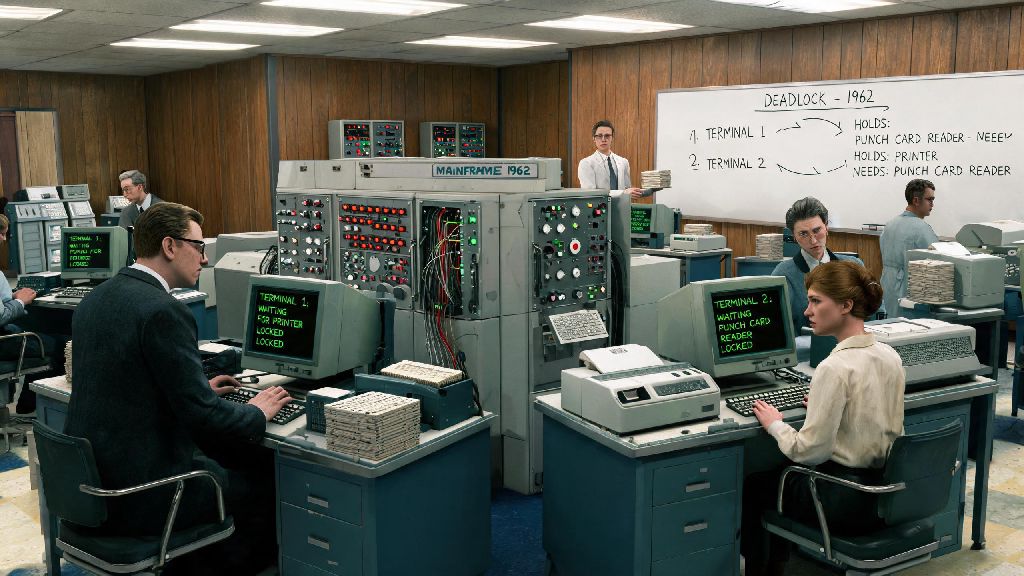
The formal study of deadlock first kicked off in the early 1960s, as research teams at MIT and other institutions built the first multi-user time-sharing operating systems. Before this era, single-task mainframes only ran one process at a time, so there was no competition for shared resources, making deadlock impossible. When systems started supporting multiple concurrent processes that shared memory, I/O devices, and CPU time, researchers began documenting the now-familiar "deadly embrace" scenario, where two processes each hold a resource the other needs, and neither will release their held resource first.
Edsger Dijkstra published the first formal paper on deadlock in 1965, while he was developing the THE operating system for the Eindhoven University of Technology. His research laid out the first framework for identifying deadlock, and by 1971, the four required conditions for deadlock (mutual exclusion, hold and wait, no preemption, circular wait) were fully formalized by other computing researchers. Early deadlock research was focused exclusively on mainframe operating systems, since consumer-facing computers didn't hit the mass market for another 15 years. Most of the core foundational development for deadlock theory was complete by the mid-1970s, but use case-specific development continued for decades after.
Deadlock Development Expansion to Databases and Consumer Software
As relational databases grew in popularity through the 1970s and 1980s, deadlock emerged as a critical problem for transaction processing systems. Databases use locks to ensure transaction integrity, so two concurrent transactions competing for row or table locks can hit deadlock just like operating system processes. During this era, database developers built the first automated deadlock detection and recovery tools, which could identify deadlocks in seconds and terminate low-priority transactions to resolve the issue without restarting the entire system.
By the 1990s, deadlock became a concern for consumer software too, as home PCs adopted multi-tasking functionality that let multiple apps run at the same time. Operating system developers added background deadlock monitoring tools that would automatically resolve minor deadlocks without any input from the user, reducing the frequency of full system crashes. Many people don't realize deadlock can even impact consumer-facing apps that rely on real-time sync between user devices and cloud servers. For example, online gaming platforms that let multiple users join the same table and make concurrent requests can run into deadlock if their sync logic isn't optimized, leading to frozen lobbies or lost progress for players. Casual game platforms that run real-time card and table games are particularly prone to this type of issue, and teams behind platforms like Rummy888 invest heavily in pre-deployment deadlock testing to avoid disrupting user sessions during peak play times.
By the mid-1990s, deadlock prevention frameworks were standard for all enterprise-grade database and operating system products. Most teams had access to off-the-shelf tools to detect and resolve deadlocks, but the rise of distributed systems would soon create entirely new deadlock challenges that existing frameworks couldn't address.
Common Misconceptions About Deadlock Development
A lot of new developers assume deadlock is a fully solved problem that no one needs to worry about anymore, but that's far from the truth. While core deadlock theory hasn't changed much in 60 years, modern distributed architectures like microservices and serverless create distributed deadlock scenarios that early researchers never anticipated. Distributed deadlock happens when multiple services across different servers hold resources other services need, and there's no centralized resource manager to track locks across the entire system. These deadlocks are much harder to detect and resolve than traditional single-system deadlocks, so active research in this area is still ongoing.
There are a few other common misconceptions that lead teams to overlook deadlock risk in their systems:
Distributed deadlock research is still an active area of development as of today, with new algorithms being released regularly to address gaps in cloud and microservices environments. Most major cloud providers now include built-in deadlock monitoring tools for their serverless and microservices offerings, to help teams catch issues before they impact end users.
Practical Steps to Reduce Deadlock Risk in Your Systems
You don't need a deep background in theoretical computer science to reduce deadlock risk in your systems, no matter what type of product you're building. The first and most effective step is to enforce a consistent lock ordering for all shared resources in your system. If every process or transaction requests locks in the exact same order, you eliminate the circular wait condition, which removes almost all deadlock risk for single-system architectures.
Second, set clear timeouts for all lock requests, so if a process can't get access to a required lock within a set time frame, it automatically releases all locks it's currently holding and retries the request after a short delay. This prevents processes from holding locks indefinitely while waiting for another resource, which eliminates the hold and wait condition for most scenarios. You should run deadlock stress tests as part of every pre-deployment pipeline, especially if you're launching updates that change how your system handles resource locking. These tests simulate high-concurrency scenarios to catch hidden deadlock risks before they reach production.
For distributed systems, use centralized lock management tools that track all lock requests across your entire architecture, so you can detect distributed deadlocks in seconds instead of hours. For consumer-facing apps, prioritize resolving deadlocks that impact user sessions over those that only impact background processes, since user experience directly affects retention and revenue. Even small teams can implement these steps with minimal time and resource investment, and the payoff in reduced outages and better user experience is well worth the effort.
When you're asking how long has deadlock been in development, it's clear that the core concept has existed for more than 60 years, but it's still evolving to match the changing needs of modern computing. What started as a problem exclusive to mainframe operating systems now impacts everything from small mobile apps to global distributed cloud platforms, and staying up to date on the latest deadlock prevention and mitigation techniques is a non-negotiable skill for anyone working in systems design or software development. You don't need a PhD in computer science to reduce deadlock risk in your systems, just a solid understanding of core concepts and a commitment to testing and monitoring your systems regularly.