If you’ve ever waited 10 minutes for a cloud app to load only to get a timeout error, or watched your company’s inventory database freeze mid-transaction in 2026, there’s a good chance deadlock was to blame. Many tech teams write off these random freezes as generic glitches, but taking the time to answer where is deadlock from can save you hours of downtime and thousands in lost revenue every quarter. I’ve worked in DevOps for 8 years, and I’ve seen teams lose entire launch windows because they didn’t understand the root causes of this common system issue, instead wasting time restarting servers over and over without fixing the core problem.
Core System Conditions That Answer Where is Deadlock From
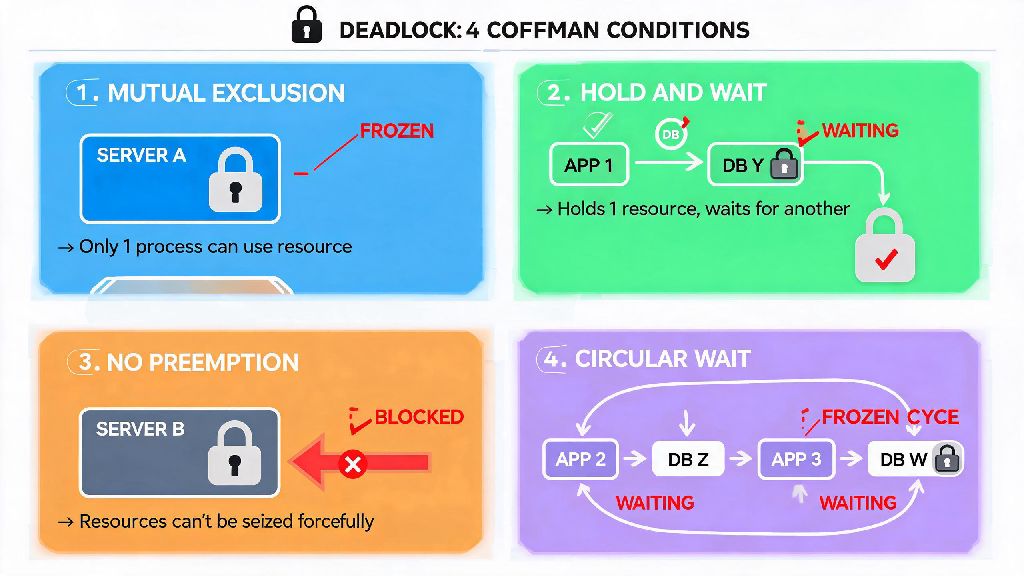
You might have heard of the four Coffman conditions before, but most explanations skip how they show up in 2026 modern tech stacks, not just old textbook operating systems. All four of these have to be present at the same time for a deadlock to form, and missing even one means it can’t happen. Mutual exclusion is the first condition, which means one resource can only be used by one process at a time: think of a 2026 cloud storage lock that only lets one user edit a file at once. Hold and wait comes next, when a process is holding one resource already while waiting for another that’s held by a different process: for example, your e-commerce checkout system is holding the user payment data lock while waiting for the inventory stock lock, which is held by a separate restock process. No preemption is the third condition, meaning the system can’t force a process to give up a resource it’s holding before it finishes its task: most modern database systems don’t allow force-revoking locks mid-transaction to avoid data corruption, so this is extremely common in 2026 deployments. The final condition is circular wait, where each process in the chain is waiting for a resource held by the next process in the loop, so no one can move forward.
Most Common Deadlock Triggers in 2026 Tech Stacks
Textbook conditions are one thing, but you’re probably wondering what actually causes deadlocks in the systems you use every day in 2026. If you’ve ever spent hours trying to trace a random freeze, understanding these triggers makes it much easier to answer where is deadlock from without digging through thousands of lines of code. From my experience troubleshooting hundreds of deadlock events over the past two years, these are the most frequent triggers I see:
How 2026 Tooling Changes Deadlock Origins
A lot of old deadlock guides were written before AI workloads and serverless architectures became mainstream, so they miss a whole set of new deadlock origins that are super common in 2026. For example, many teams use AI model inference endpoints that lock GPU resources for long running jobs, and if multiple inference requests are queued with different resource requirements, you can get deadlocks across your entire GPU cluster that aren’t covered by traditional operating system deadlock rules. Serverless function cold starts are another new trigger: if a serverless function is waiting for a resource lock while it’s being initialized, and another function is holding that lock while waiting for the first function to return a data value, you get a deadlock that’s almost impossible to trace because serverless environments hide most of the underlying process data. A lot of teams assume that managed cloud services eliminate deadlocks entirely, but that’s not true at all—they just move the deadlock origin from your on-prem servers to the shared resource layers of your cloud provider, which are even harder to troubleshoot if you don’t know what to look for.
Quick Checks to Identify Deadlock Origins in Your Systems
You don’t need to be a systems programming expert to figure out where a deadlock is coming from when you have an outage. I always walk teams through these simple first steps that work for 90% of 2026 deadlock cases, no special tooling required. First, pull your database lock logs from the 10 minutes before the outage: if you see two transactions that each hold a lock the other is waiting for, that’s your culprit, and you just need to adjust the order you lock tables in those queries. Next, check if you rolled out any new microservices or shared resource workflows in the past 24 hours: most deadlocks are triggered by new code changes, not random existing system glitches. Avoid restarting all your servers immediately if you can, because that erases all the lock and process data you need to find the root cause, and you’ll just end up with the same deadlock again a few days later. If you’re dealing with a GPU or serverless deadlock, check your cloud provider’s resource usage dashboards first—most 2026 cloud platforms have built-in deadlock detection flags for shared resources that will point you directly to the problematic process chain without any extra work on your end.
Deadlocks don’t have to be a mysterious, unavoidable part of running tech systems in 2026. Once you take the time to learn where is deadlock from, you can spot most triggers long before they cause costly outages, and fix them with small changes to your code or workflow instead of expensive overhauls. Even if you’re not a senior systems engineer, understanding the core conditions and common triggers will help you contribute to more stable systems for your team, and save everyone a lot of late nights troubleshooting random freezes. Next time you run into an unexplained system freeze, skip the immediate server restart and take 10 minutes to check for the patterns we covered here—you’ll be surprised how often you find the root cause right away.